

State Law Enforcement Chief Voluntarily Demoted
After an unsuccessful run for Honolulu’s top police job, Mike Lambert is staying at the state law enforcement agency, but not as its leader.
Earlier this year, Mike Lambert threw a curve ball: He was leaving the top job at the Hawaiʻi Department of Law Enforcement and returning to the Honolulu Police Department.
The move was the only way to obtain the full retirement benefits for 21 years of HPD service, he said. And he was applying to be HPD’s chief. As the only local candidate, he drew strong endorsements from Gov. Josh Green, Mayor Rick Blangiardi and 90% of the rank and file officers represented by the police union.
But in June, Honolulu’s police commission picked David Lazar to lead HPD, leaving Lambert in an awkward position. He’d already nominated his deputy, Jared Redulla, to take the lead of DLE.
Now Lambert is still serving the agency he headed, but in a civil service position as chief special investigator. And he is taking the hit to his pension benefits that he had wanted to avoid.
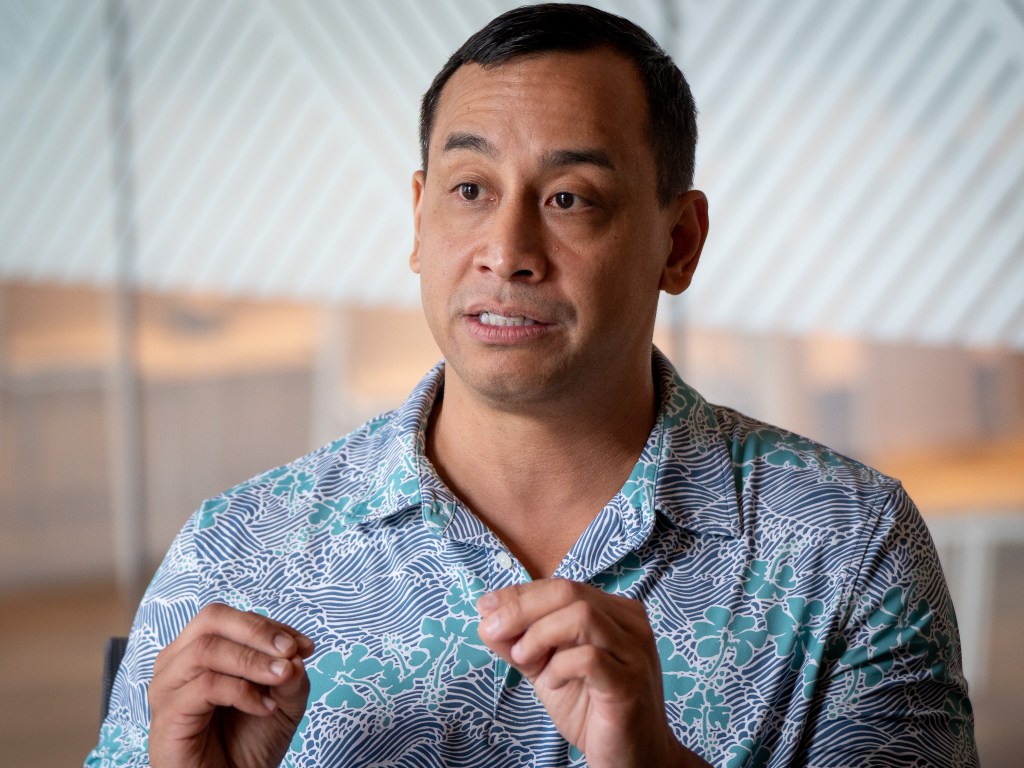
In Lambert’s new role, he will administer DLE’s investigation divisions working on narcotics, illegal firearms, fireworks and agricultural crime, including large-scale theft, illegal hunting and trespassing.
“The reason why I stayed, even though going back to HPD would fix my retirement situation, was I made a lot of commitments,” he said, particularly to the agricultural community, “and now those crimes are starting to be taken seriously.”
He has no regrets about his decision, he said, and is grateful for the opportunity he has now.
“I know what people are going to say – that I jumped ship – but that’s a disappointing comment because my agency and title may be different but my commitment to the community never changed,” Lambert said.
However, some public whiplash is understandable because of his public commitment to return to HPD.
The scenario has parallels with former Big Island police chief Ben Moszkowicz who resigned in anticipation of a successful run for HPD chief, and ended up out of both jobs. Lambert however managed to keep his foothold at DLE.
Retirement Benefit Hit
Lambert’s appointment to DLE resulted in a $20,000 annual hit to his retirement because service at the director level with the state would accumulate a lower pension benefit than service with the city.
He had said at the time of his appointment that unless new legislation — House Bill 2358 in 2025 — closed the gap between the county and state retirement programs, he would be returning to HPD.
“It would be like I never left,” he said. “There would be minimal adjustment to the overall calculation.”
But that legislation never even received a hearing. The chair of the Senate labor committee, Brandon Elefante, killed the bill. He said the legislation would only benefit six individuals, including Lambert.
Lambert passed on a possible deputy role under Lazar, and followed through with the decision to step down from the DLE leadership role this past summer.
Lambert, without elaborating, said that it was unclear to him how would fit into Lazar’s department in that role.
As it stands, Lambert will forfeit 11% of his retirement payout, because the special chief investigator job carries the same retirement penalty as the director.
Redulla will go before the state Senate in January for confirmation.
Weighing The Options
Lambert said the chief special investigator position was not created as a soft landing for him after he was passed over for chief.
The job had been created in 2004 within the Attorney General’s Office. That position moved over in 2024 when the state Department of Law Enforcement was established and was sitting vacant, he said. Although it’s an administrator position, it requires an extensive investigative background, Lambert said.
“So of course in my time in HPD, I was a narcotics vice detective. I did gambling, and I came back as the narcotics major,” he said.

A job listing shows that the position was posted for 10 days between June 19 and June 29, and there were about a dozen candidates, Lambert said. For a state job, it was a pretty fast turnaround.
He attributed that to the outsourcing of the hiring process to the state’s human resources department, a step meant to ensure there was no conflict of interest.
The investigator role is an “excluded managerial” position with an annual salary range of between $125,136 and $200,256. Last year, Lambert had told legislators that his $179,436 salary as director was about $5,000 a year less than he would make if he was back in his old job as HPD major and that the state salaries continued to make it harder to fill the state positions.
Lambert says his decisions in the last six months have been about ensuring he is “putting a roof over his family’s head” and ending up in a role where he felt he could have the most impact. His new role provides a “clearer pathway of job satisfaction to work on things I feel are important.”
‘We Have Broken The Inertia’
DLE Acting Director Redulla said in a statement that Lambert will be integral to continuing efforts against illegal fireworks and agricultural crime — initiatives which “gained a lot of traction” during Lambert’s tenure as director.
After a deadly fireworks explosion on New Year’s Day 2025 that killed six and injured many more, Lambert was the face of the state’s response. The agency started deploying drone technology to monitor illegal firework activity and issued more citations for offenses. Lambert called for a five-year ban on importing fireworks.

And when Waiʻanae rancher Cranston Pia was killed during a confrontation with hunters trespassing on his property in February 2024, DLE was given the responsibility of addressing largely unchecked crime on Hawaiʻi agricultural land.
Lambert helped establish a pilot agricultural crime unit the following June, working with communities on a $1 million pilot project on the Big Island and the North Shore of Oʻahu.
Agricultural crime, estimated to cost Hawaiʻi producers between $3 million and $4 million per year, was a centerpiece of a recent interagency enforcement conference.
State Senator and Big Island rancher Tim Richards, said Friday that he “was ecstatic” that Lambert would be staying on because Lambert “had done a bunch of the groundwork” to create a coordinated interagency response to the issue.
“We’ve broken the inertia on this,” Richards said, and he was planning to pursue a slate of funding proposals to tackle agricultural crime in the next legislative session.
Lambert has also been a strong advocate for drone technology. DLE recently expanded its enforcement efforts with a new fleet of drones equipped with cameras, thermal imaging and loudspeakers to help officers locate illegal hunters, according to the agency’s public information officer David Patterson.
And Lambert has been very hands-on establishing a network of 400 surveillance cameras across the state that will be used to monitor state roads and other locations, including some Hawaiian homelands.

