'I Have To Be Involved': Natalie Iwasa Has Been Rocking The Boat For 20 Years
The Hawaiʻi Kai accountability advocate has advice for other residents who want to tackle community issues.
November 1, 2026 · 9 min read


About the Author

Driving to meet Natalie Iwasa for an interview on a Sunday afternoon at Kāhala Mall, I glanced to my right and there she was. The Bike Mom, pedaling hard up Kalanianaʻole Highway in a bright yellow long-sleeved T-shirt, eyes straight ahead and focused. She didn’t see me waving wildly. She was pumping along steadily, on her own terms.
That, I thought, just about says it all.
For more than 20 years, Iwasa has been one of the most determined advocates for government accountability and transparency in Honolulu. Her low key yet persistent style — whether it’s testifying before the City Council or adding to the discussion in Civil Beat’s comment section — has caused people and politicians to pay attention.
She doesn’t always win, as was the case with her two runs for City Council or the recent lawsuit where she was lead plaintiff in a bid to keep City Council Chair Tommy Waters on the August primary ballot.
“Have I made a difference? Absolutely,” Iwasa says. “You don’t go in there expecting you’re going to change something just because you say something. There’s a lot of opinions on different issues.
“But to not do anything? I don’t think that’s a good solution because then our democratic society doesn’t work.”

Iwasa is a certified public accountant and fraud examiner, and much of her watchdog mindset is with an eye toward the financial details behind a project or an issue. It might be the thing that is best known about her.
But here’s a little tidbit she shared in our interview: She flunked accounting in college the first time around.
That was in the early 1980s back in Wisconsin where she’s from. She started as an accounting major but it was not to be.
“We had to buy a book, actually this big,” she says, spreading her fingers wide. “What is that, 3, 4 inches? … Anyway, bottom line is I flunked out.”
That landed her a job with Kelly Services in Minneapolis which is where she was working in 1985 when she came to Hawaiʻi for a family reunion hosted by her uncle who lived here while he was in the Air Force. He offered to let her stay with him, so she found a job on Oʻahu with the same temp company and headed across the Pacific.
After a short stay in Wahiawā she moved to Hawaiʻi Kai in 1988 and has been there ever since.
She ended up doing more bookkeeping, which led her to classes at University of Hawaiʻi and Hawaiʻi Pacific University and, finally, that accounting degree.
“I got straight As, passed the CPA exam — all four parts — on the first try, and then became certified,” she says.
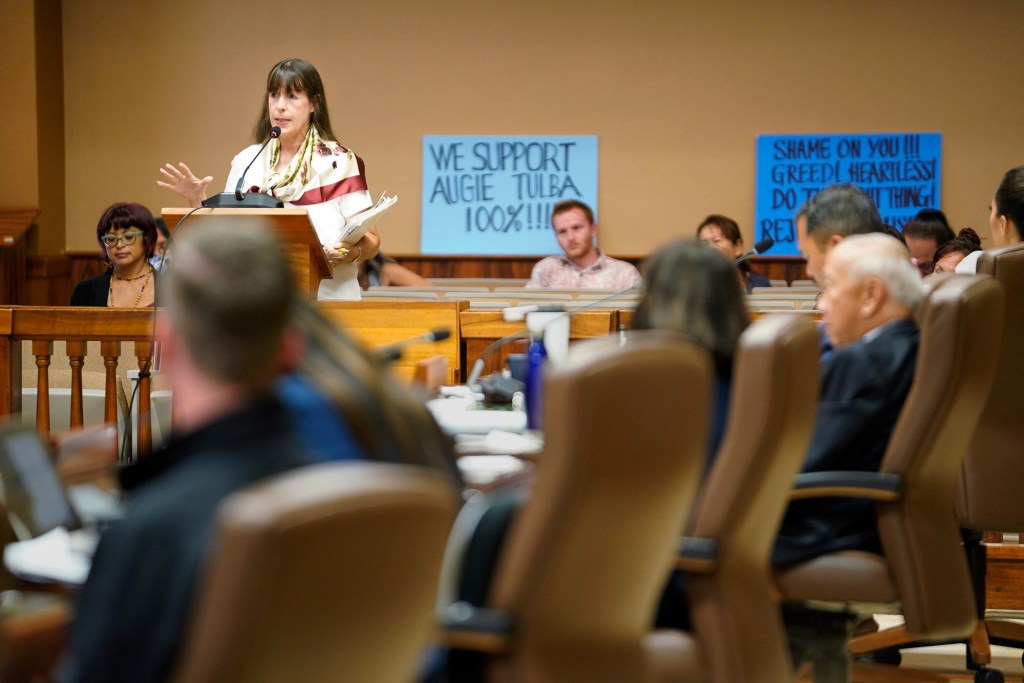
In Hawaiʻi Kai, her life settled into work and family, including raising two boys.
In 2003, she began paying attention to the growing debate over farm lands in the Kamilonui Valley and proposals to turn what were some of the last remaining agricultural lands in East Oʻahu into housing developments.
“But I had a baby and I had work and there was a petition going around and I thought, OK, someone else is doing it,” she says.
Soon, she realized, things weren’t going the way she thought they should be. She decided she needed to muster her courage and make a public stand.
There was a hearing coming up before the City Council. “It just dawned on me that if I don’t want this to happen I have to get involved. I have to tell them my opinion because otherwise things are going to happen that I don’t like and then I’d regret it.”
Advocates and farmers managed to keep full-scale development in check although a major subdivision was built on the edge of the valley. For Iwasa it was the beginning of decades of community advocacy that has included service on a plethora of civic boards as well as chair of the Hawaiʻi Kai Neighborhood Board.
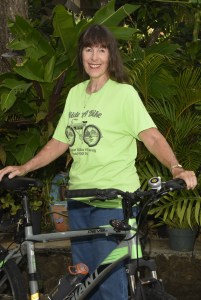
It was while on the neighborhood board that she got her nickname The Bike Mom. An avid cyclist, Iwasa was frequently seen riding around the community with her boys, one on the front of the bike and one in a bike carrier hooked behind.
“Oh, here comes the bike lady,” a Honolulu police officer remarked one evening when she pulled up at the board meeting.
“You really ought to call me the bike mom,” she replied and the name stuck.
For years, Iwasa has been involved with bicycling advocacy. Around the same time she was working on the problems in Kamilonui Valley a sewer line was going in on Lunalilo Home Road and the street was so torn up it was hard to ride the bike, especially with the kids. That took her to the City Council. Again.
As a neighborhood board member and chair she organized an islandwide push to repair streets and make improvements that would make riding safer for cyclists.
In 2008, she approached every neighborhood board and put together resolutions that 30 of the 33 boards adopted. Each was targeted at a specific geographic area but generally urged the mayor and City Council to develop new bike paths, put in more bike racks, improve bike lanes and cut back trees and vegetation that impede bike riding.
The City Council passed the resolution and then the Legislature.
“I think that’s why a lot of people know me as The Bike Mom,” she says. “I saw this gap in the bicycling infrastructure and the way bicycles were treated.”
She even had her bike stolen from Honolulu Hale while she was inside testifying.
Iwasa has become one of the leading advocates for openness and transparency in government. She’s written more than two dozen Community Voices for Civil Beat in the last 12 years, many of them questioning the costs and financial projections behind the Honolulu rail project.
She long ago overcame her stage fright and frequently testifies at council meetings, chiming in on numerous issues. Property taxes. Sewer fees. An empty homes tax. Pay raises for council members. She’s caught Sunshine Law violations by the council. Most recently she testified before the Honolulu Charter Commission on a proposal to change quorum requirements for city boards.
But the Honolulu rail project is what she has kept the closest eye on over the past two decades.
In 2021, House Speaker Scott Saiki appointed her to a non-voting seat on the board of the Honolulu Authority for Rapid Transportation.
“The City and County of Honolulu’s rail project poses a significant financial concern and there must be more scrutiny over HART decision-making,” Saiki said at the time. “Ms. Iwasa is an independent, critical thinker who is knowledgeable and who has formed her own opinions on HART and mass transit. Ms. Iwasa’s official engagement on the Board will ensure increased accountability and transparency at HART.”
Iwasa says she doesn’t mind being a non-voting member. It lets her dodge lobbyists and others who would otherwise call and pressure her into taking a certain position.
“I like that,” she says. “I can say what I want and not really worry about it too much.”
A few years ago, she famously refused to sign a non-disclosure agreement and HART officials wouldn’t let her attend executive session meetings. Restrictions on public disclosure and transparency were particularly troublesome, she says, including provisions like this one: “Never reproduce the confidential government record in whole or in part in any physical or electronic form, except with the prior approval of the Executive Director of HART.”
More recently, she worked with the HART board chair on a new agreement, one that removed those kinds of clauses and she signed. Since December she’s been back in the closed-door sessions, but on her own terms.
She says she still tries to focus her attention on what she knows best: accounting and auditing issues. Her approach is not to accuse, but merely question facts and figures.
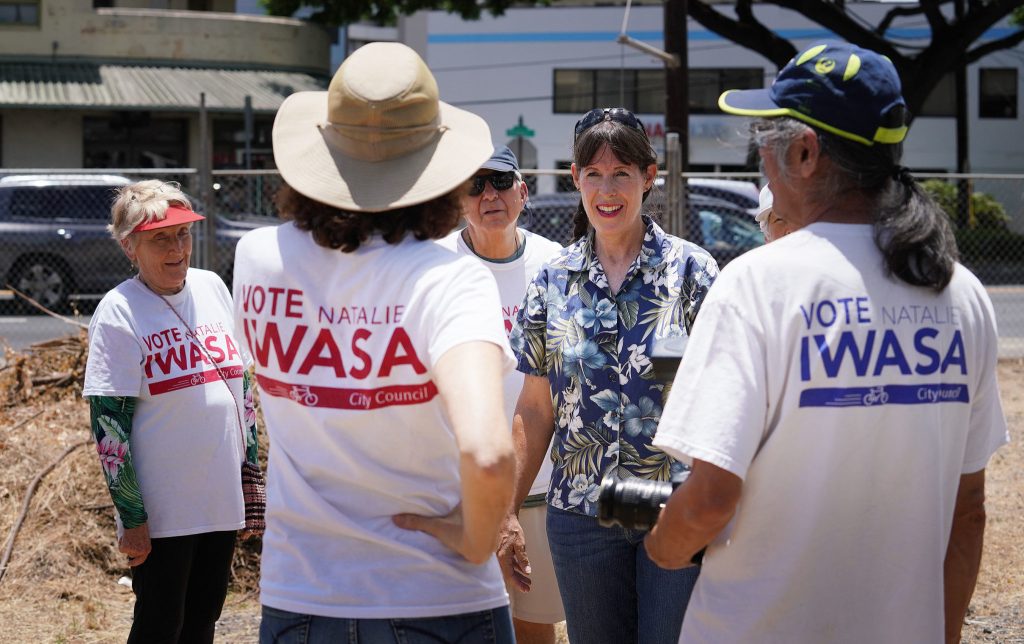
Iwasa has twice run for City Council from District 4, in 2014 and 2018. The 2018 race put her in a three-way primary against Trevor Ozawa, the incumbent at the time, and Tommy Waters. Waters would go on to win that seat but not until a special election in 2019, the final vote delayed by legal action that would play a role in this year’s primary and put Iwasa in the middle once again.
Fast forward to 2026. Waters and Ozawa were again facing off until the Hawaiʻi Supreme Court ruled — in a case brought by Iwasa and numerous other East Oʻahu residents — that Waters had already served two terms and couldn’t run again. By then primary ballots had gone out with his name on them and thousands of people had already voted.
“It was not fair to the voters,” Iwasa says. “I mean, bottom line for me, that’s it. You put out a ballot with four names on it and, halfway through the mail-in voting we learned, oh, by the way, one of them’s not eligible. Well, wait a minute. How many thousands of people submitted their ballots already?”
Twenty years of raising her voice on behalf of the public has taught Iwasa one thing: “If I want to be able to make a change I have to be involved.”
Her advice to others who have something to say but don’t quite know how to go about it is to just start small and go from there.
If you can’t get to a meeting, join by Zoom.
If you can’t testify in person, submit something in writing.
If you want to share your opinion, send a letter to the editor.
“It doesn’t have to be standing right at that podium and being nervous,” she says.
Tell us about a government program or service you think is working well. We’re also interested in people, especially public employees, who deserve to be celebrated for their service or their contributions to making Hawaiʻi a better place. Send to sunshine@civilbeat.org and include Bright Spots in the subject line please!
 Sign up for our FREE morning newsletter and face each day more informed.

Local reporting when you need it most
Support timely, accurate, independent journalism.
Honolulu Civil Beat is a nonprofit organization, and your donation helps us produce local reporting that serves all of Hawaii.
ContributeAbout the Author