Trevor Ozawa Wins Back Honolulu City Council Seat, 8 Years Later
Voters also sided with measures backing data innovation, food security and protection for immigrants — and they want to punish politicians who are impeached.
With most votes counted, Trevor Ozawa is on track to comfortably beat his opponent Tara Malia Gregory and win reelection to his old City Council seat representing East Honolulu.
As of the second printout of election results, which includes mailed ballots received through Monday, Ozawa had 60% of the vote to Gregory’s 29%. More than 11% of voters left that race blank on their ballot.
The district covers over 100,000 residents living between Waikīkī and Hawaiʻi Kai. Ozawa previously held the nonpartisan position from 2015 to 2019. Gregory, a first-time candidate, had a robust online following but nevertheless trailed Ozawa in name recognition and campaign spending.
Also on the Honolulu ballot, incumbent Councilman Tyler Dos Santos-Tam beat first-time candidate Corey Morihara with 65% of the vote. Morihara had 22%, with remaining voters leaving that race blank. Dos Santos-Tam is set to keep his seat representing an area covering downtown Honolulu and Kalihi, and he is gunning to be the next council chair.
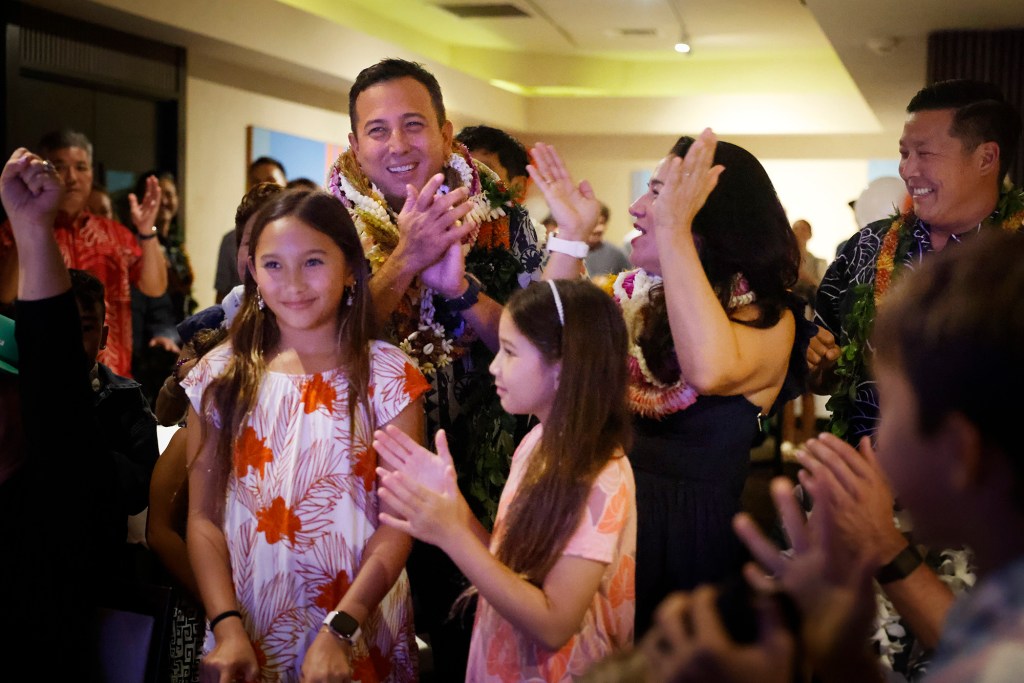
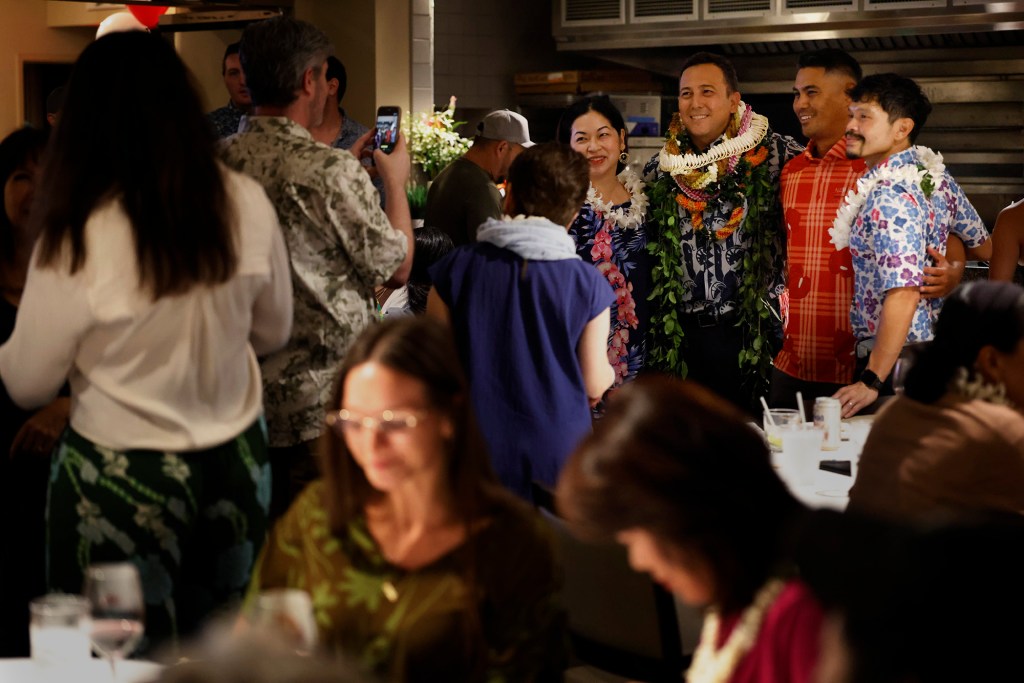
More than 60 Ozawa supporters gathered Tuesday evening in an upstairs area of the restaurant Roy’s, a Hawaiʻi Kai staple where Ozawa suffered through his defeat to Waters during their last matchup in 2019.
Ozawa, sporting a big collection of lei, periodically posed in group photos as people mingled at tables drinking wine and eating catered food. Kids played with clusters of red, white and blue balloons.
The crowd quieted shortly before 8:10 p.m. to watch Hawaii News Now report the election results, groaning when the news shifted to talk about Maui results. When Ozawa’s results rolled in, the crowd clapped, cheered and then chanted his name: “Trevor! Trevor! Trevor! Trevor!”
“Trevor, you’ve shown what a leader you are,” campaign co-chair and the state’s former first lady Vicky Cayetano said into a microphone at the front of the crowd. “I see a little bit of Ben in you.”
Ozawa took the microphone soon after.
“As I sat here,” he said, “as a private citizen, I know what can actually make us a better community, and I wanted to do stuff over the last eight years.”
He pledged to work well with the administration, his fellow council members and his community. The little things, he said, will be his priority: “parks, permitting and all the problems that you guys bring to me.”
“We can’t have somebody sitting around in that office waiting for their title to do just do the job,” he said. “It’s not going to happen.”
Asked about the council’s impending leadership change, Ozawa said he plans to work with whoever’s in charge.
Ozawa Regains Former Seat
Both Ozawa and Gregory made the case that government could do a better job spending tax dollars on worthwhile projects as residents struggle with the city’s high cost of living. Money collected each year goes unspent as residents endure basic infrastructure deficiencies, they said.
As his campaign wrapped up, Ozawa emphasized wanting to fix everyday issues such as janky park bathrooms and uneven sidewalks.
“We pay the highest cost of living in the country,” he said recently on ʻŌlelo Community Media, “and too often, what we get back from our government doesn’t match what we put in.”
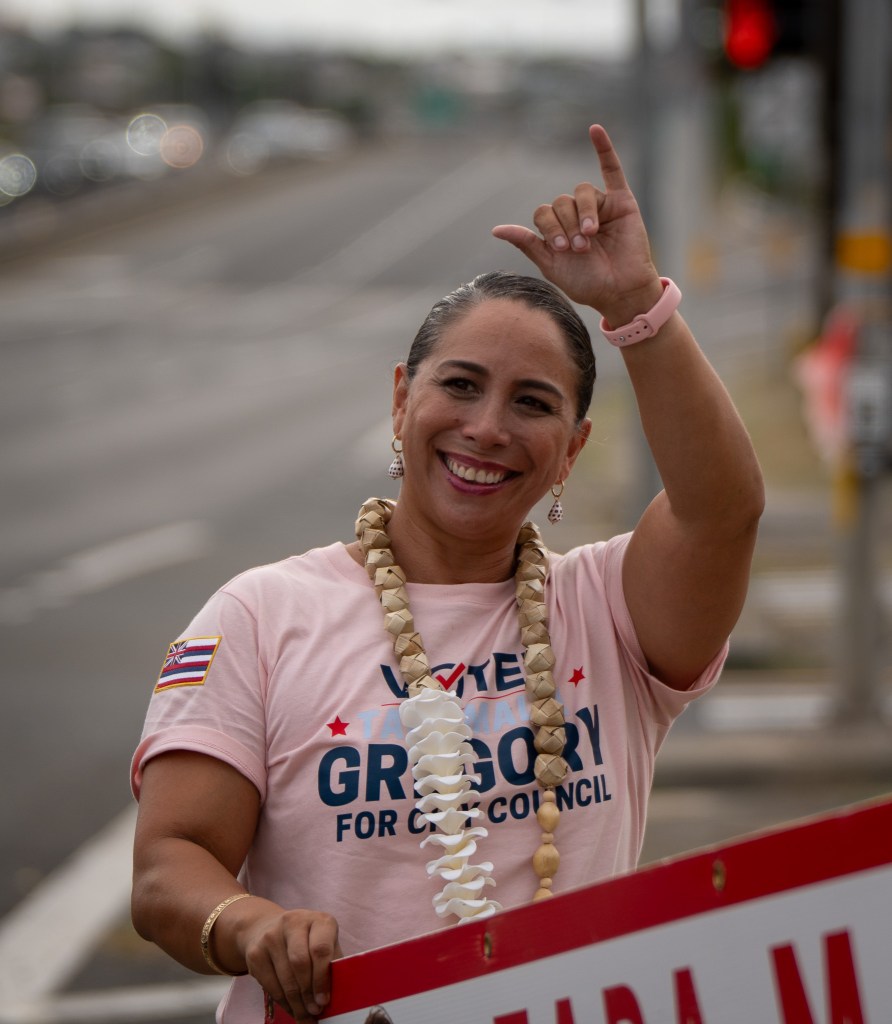
Gregory campaigned with a two-word motto: Audit everything.
And she really did mean everything, she told a small group at one of her recent Talk Story events at ʻĀina Haina Public Library. Gregory, who was involved in local Republican politics before deciding to run for the council, focused her message on criticizing inefficient government spending.
After the results came out, Gregory said in an interview that she hopes Ozawa accomplishes his goals in office. She said she wanted to win, of course, but she’s not discouraged and sees this campaign as the beginning of being more politically involved in the future.
She also said she plans to run for office again. “There’s a lot of crazy people out there just like me,” she said, referencing the almost 10,000 people who voted for her.
Ozawa’s win marks a sharp change from how the race was shaping up at the beginning of the year.
At the time, Council Chair Tommy Waters was making his bid for a legally questionable third consecutive term in office. In June, however, Ozawa joined the race. He filed a lawsuit against Waters’ candidacy, which eventually reached the Hawaiʻi Supreme Court and led to a split vote deeming Waters ineligible for reelection. By then, more than 8,000 people had already voted for Waters in the primary.
Gregory was the third biggest vote-getter in the primary, and with Waters out of the way, she advanced to the general election.
Leading up to the November election, Ozawa shifted his campaign message away from criticizing Waters’ run and focused more on small-scale problems such as feral chickens run amok.
Kāhala voter Parker Kilkenny, a law student who Ozawa met while door-knocking last month, said she appreciated this approach.
“I like the very realistic goals that he presented,” she said.
Friendly and charismatic, Gregory connected well with voters when she went door-to-door. But she left her more controversial beliefs mostly unsaid, including conspiracy theories that local government officials purposefully burned down Lahaina, that Covid vaccines are dangerous and that President Donald Trump won the 2020 election. All of these beliefs are false.
Kilkenny, for her part, said she was turned off by Gregory’s skepticism regarding Lahaina.
“I don’t really appreciate conspiracy theories floating around about that,” she said.
Still, during Gregory’s encounters, she met some people who had become disenchanted with Ozawa after his first term in office.
He had a reputation for being disagreeable. A city internal investigation concluded he acted unprofessionally and disrespectfully toward a female council staffer who campaigned for his opponent, Hawaiʻi News Now reported in 2019. He has indirectly sought to distance himself from that reputation, saying that during the past eight years he has grown to become a more effective communicator.
Ozawa will enter a council in flux. After six years of Waters’ leadership, members are looking to install a new chair. Council member Tyler Dos Santos-Tam submitted a resolution last week to make himself the top dog. He is the current frontrunner after a private meeting between himself and four other council members at Zippy’s Waipahu that may have broken the state’s public meetings law. The Office of Information Practices said last Thursday they are still investigating the case.
It’s unclear how Ozawa’s presence will impact the council’s political dynamics after he’s sworn in on Jan. 2.
Ozawa was the frontrunner for council chair in late 2018 until the Supreme Court invalidated his narrow win against Waters, setting up a rematch in the spring, which Waters won.
Voters Approve Charter Amendments
Honolulu voters approved several of the 20 charter amendments on the ballot, including to create a new Office of Data and Innovation and a Food Security Fund. Another proposal to use ranked choice voting no sooner than 2032 did not pass.
Voters approved a measure to prohibit impeached politicians from holding political office for two years and OK’d a measure aimed at protecting the rights of immigrants during police encounters.
The language of all the charter amendments can be found here.
Some voters said they spent roughly half an hour filling out their ballots, much of which entailed figuring out where they stood on the charter amendments.
“It’s not easy to understand,” said Kalihi resident Jacqueline Velasco, 49, who said she had to take a break. “My brain was shutting down.”
She said she voted to reelect council member Tyler Dos Santos-Tam, whom she had a positive impression of after meeting him in person a couple years ago as he door-knocked with then-Rep. John Mizuno.
Kilkenny, the law student, said she voted yes on a lot of the charter amendments, including to establish ranked-choice voting, start a food security fund and create an Office of ʻŌiwi Resources and Cultural Stewardship.
“I felt like I understood all of them,” she said, “but I also am a law student.”