Denby Fawcett: This Major National Arts Foundation Is Expanding To Honolulu
A New York nonprofit is spending millions in Hawaiʻi to celebrate immigrants’ contributions to the arts and sciences.
June 23, 2026 · 8 min read

About the Author
In the Trump era of vilifying immigrants, it is uplifting to discover a New York family has been quietly contributing thousands of dollars in grants to Hawaiʻi establishments to celebrate and raise awareness of the artistic and scientific contributions of the foreign born.
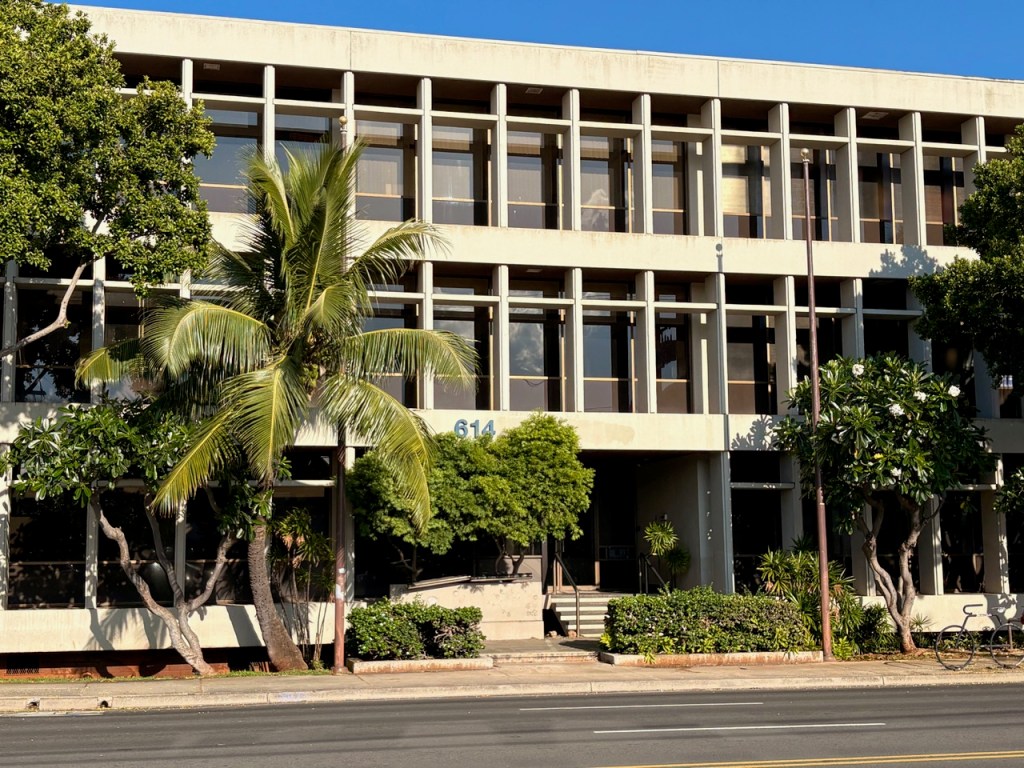
I had never heard of the Vilcek Foundation — started by immigrants Jan and Marica Vilcek — until I read reports that the Manhattan-based nonprofit is planning to have a major physical presence here, paying $15 million to buy the former Locations real estate company’s building at 614 Kapahulu Ave.
The three-story, 32,000-square-foot building on the corner of Kapahulu and Date is probably best known as the former site of the Side Street Inn, which is now closed. Vilcek is expected to turn the fortress-like concrete structure into offices, meeting rooms, art storage spaces and an art gallery although it has not yet announced specifics of the remodeling.

Ideas showcases stories, opinion and analysis about Hawaiʻi, from the state’s sharpest thinkers, to stretch our collective thinking about a problem or an issue. Email news@civilbeat.org to submit an idea or an essay.
Vilcek Foundation president Rick Kinsel in an email explained why Honolulu was selected to be the foundation’s second headquarters.
“Over the past decade, the foundation researched many potential locations for a second site,” he said, “but Hawaiʻi — and Oʻahu, in particular — stood out. In leading this project, it was imperative to me to identify a city that has been profoundly shaped by immigration, and that also honors the Indigenous community.”
Grants officer Liz Boylan in a phone interview from New York said Hawaiʻi is a good fit for the foundation because immigrants have been making contributions to the islands for a long time.
Unlike many cities where immigration is a more recent phenomenon, mass immigration to Hawaiʻi stretches back almost two centuries to the beginning of the plantation era when laborers from Japan, China, Korea and the Philippines began arriving to work in the sugar and pineapple fields with many staying to make the islands their permanent home.
Today, about 1 in 5 Hawaiʻi residents are foreign born.
Many cities in the U.S. now have large immigrant populations but Hawaiʻi is one of few places in the country where descendants of immigrants from many different countries have become key leaders of the mainstream culture.
The Vilceks’ own immigrant journey is a saga of giving back to their adopted country through their professional accomplishments and later, when they prospered, through their philanthropy.
Jan and Marica Vilcek arrived in New York in 1965 after fleeing from Communist Czechoslovakia at the height of the Cold War. Marica had a Ph.D. in art history. Jan was a physician and biomedical researcher.
After they settled in Manhattan, Marica worked in the library of the Brooklyn Museum, eventually advancing in her career to become one of the chief curators of the Metropolitan Museum of Art. She died at age 89 in March.
Jan, 93, is the chairman and CEO of the foundation. While working as a professor of microbiology at New York University’s Langone medical center, he and a colleague discovered the biological basis for Remicade, a breakthrough drug that halted the inflammation underlying many serious autoimmune diseases such as rheumatoid arthritis and Crohn’s disease.

Jan donated his inventor’s royalties from Remicade and two other drugs to launch the Vilcek Foundation in 2000 which they initially ran out of the kitchen of their Manhattan apartment. He told a New York Times reporter in an interview that at the time he had no idea the inventions would become the highest revenue-generating drugs in the world.
The reporter asked if he knew then would he have given the foundation less of a share. “No,” he said laughing,” I would have given more.”
Catherine Whitney, the chief curator at the Honolulu Museum of Art, says the Vilceks have not been “showy people.”
“They worked hard their whole lives, keeping their heads down, pushing at what they did to be able to give back,” Whitney says. “They have plenty of money they could have spent on yachts, multiple houses in Aspen or on children. They have no children. Instead, they have been quietly generous, offering grants to support fun, exciting, cool things with the goal of making it easier for people who might be struggling.”
Whitney is a Vilcek Foundation board member. She became friends with the Vilceks 25 years ago in Santa Fe, New Mexico, where she worked for an art dealer the Vilceks visited to buy artworks for their collection.
Today, the foundation operates out of a five-story neoclassical landmark it owns at 21 East 70th St. in Manhattan’s Upper East Side. The building features two floors dedicated to public exhibition space showcasing some of the couple’s art collection which includes six paintings by Maui-born Tadashi Sato, whose parents immigrated from Japan.
In the 25 years since it started, the Vilcek Foundation has given more than $17 million in grants, prizes and contributions to nonprofits in all 50 states and U.S. Territories including $20,000 to the Breaking Wave Theater Co. in Guam.
In Hawaiʻi since 2007, the foundation has awarded more than $850,000 to organizations including the Hawaiʻi Youth Symphony, B+HARI Brain Health Applied Research Institute, Liljestrand Foundation, the Popolo Project and Hawaiʻi International Film Festival — the first local organization to receive a Vilcek grant.
Most recently, it awarded the Honolulu Museum of Art a $20,000 grant to help sponsor its current exhibition, “Divine Disruption: The Art of Tsherin Sherpa.” Tsherin is an immigrant to the U.S. from Kathmandu, Nepal. His exhibition features contemporary depictions of traditional Buddhist gods and goddesses as he imagines them carrying their spirits with them from the Himalayas to survive as immigrants in the United States.

Anderson Le, the artistic director of the Hawaiʻi International Film Festival, says the Vilceks’ annual grants of about $50,000 have helped it show more films from many more countries and helped launch the careers of previously unknown artists like the now widely recognized film director who goes by the single name Hikari. Hikari got a break when she was awarded a Vilcek grant to show her student film in the festival when she was attending USC’s School of Cinematic Arts. Since then, the former student — who was born Mitsuyo Miyazaki in Japan — has gone on to direct major Hollywood films and television series.
Le said the foundation not only awards grants and prizes to actors and directors but also to artists working behind the scenes such as cinematographers, artistic directors and costume designers.
“Their grants show it takes a village to make a film,” he said.
Sophia Mislang, a University of Hawaiʻi Mānoa student who attended the film festival last year and is now a HIFF intern, said the New American Perspectives program that the Vilcek Foundation annually sponsors inspired her to study to become a filmmaker.
“As an immigrant who left the Philippines at a young age, was raised in Japan and now lives in Hawaii, I have spent much of my life thinking about identity and belonging. That’s why seeing immigrant artists share their films on a big screen was incredibly meaningful to me. It showed me that my voice, especially as an immigrant, was worth telling. HIFF made me believe that my dream of becoming a filmmaker is not just some delusion or an unrealistic goal, but something that I can achieve when I choose to do so,” Mislang wrote in her intern application.
Vilcek support also requires community engagement and education programs to ensure the grantees and prize winners share their talent with the community. Grantees are expected to teach master classes and encourage students at Hawaiʻi private and public schools.
The foundation also gives smaller, unexpected gifts. Le said it has bought blocks of tickets to give to high school and University of Hawaiʻi students who might otherwise be unable to attend the film festival.
Whitney sees the foundation’s new Honolulu headquarters not as competing with other organizations here but enhancing and expanding artistic and scientific opportunities for everyone in Hawaiʻi.
 Sign up for our FREE morning newsletter and face each day more informed.
Local reporting when you need it most
Support timely, accurate, independent journalism.
Honolulu Civil Beat is a nonprofit organization, and your donation helps us produce local reporting that serves all of Hawaii.
ContributeAbout the Author