

Bill To Reform Jones Act Reintroduced In Congress
U.S. Rep. Ed Case says the federal law drives up costs for imported goods to places like Hawaiʻi.
Three legislative proposals introduced Friday in Congress seek to amend a century-old federal law that the introducers say “creates crippling monopolies on shipping lifelines” for remote jurisdictions such as Hawaiʻi and Alaska.
The bills were introduced by U.S. Reps. Ed Case (D-HI) and Rep. James Moylan (R-Guam).
The Merchant Marine Act of 1920, also known as the Jones Act, requires that all cargo shipping between U.S. ports occur exclusively on U.S. — and not foreign — flagged vessels. It also requires that the vessels be built in the U.S. and owned and crewed by U.S. citizens.
“Our three bills aim to end a century of federally-created, monopolistic, closed-market domestic cargo shipping to and from our isolated and shipping-dependent homes,” Case said in a press release.
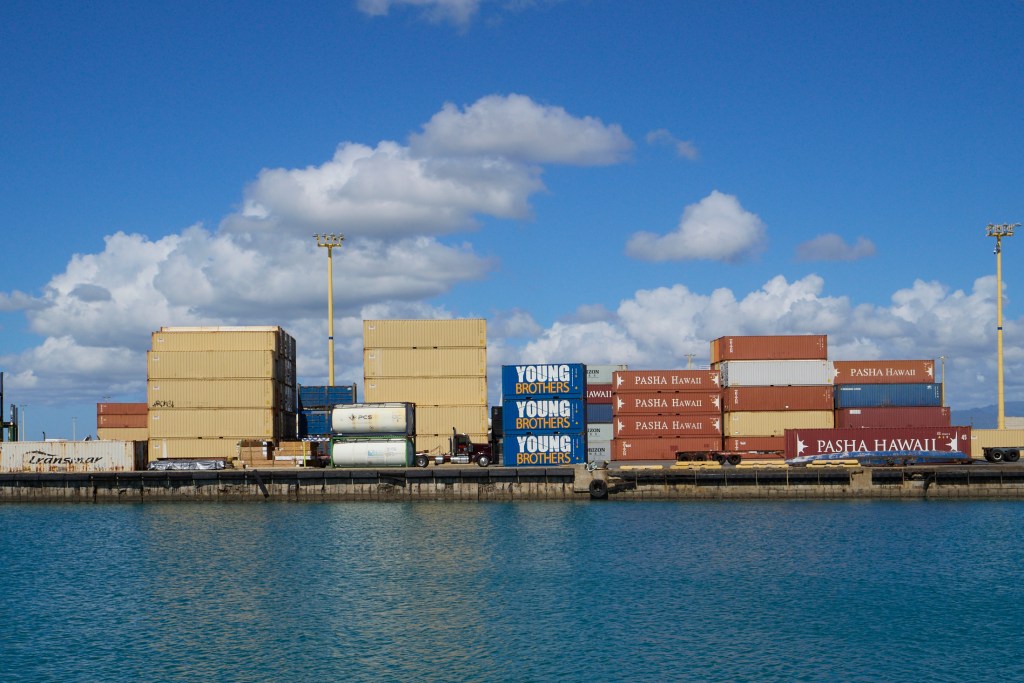
“In doing so, they target one of the key drivers of our astronomically high costs of living: domination of our lifelines to the outside world by a small group of federally-protected shipping companies that are shielded from any effective competition for service and rates, forcing us to pay far more for both shipping and goods than virtually anywhere else in the world.”
Case and Moylan argue that the Jones Act artificially inflates the cost of “critical imported goods” to the noncontiguous parts of the United States — i.e., Hawai‘i, Guam, the Northern Marianas, American Samoa, Puerto Rico, the Virgin Islands and Alaska.
Hawaiʻi, case said, is “a classic example” of the problems the act has wrought.
“Located almost 2,500 miles off the West Coast, we import well over 90% of our life necessities by ocean cargo,” he said. “There are plenty of international cargo lines who could and would compete for a share of that market. Yet only two U.S. flag domestic cargo lines — Matson Navigation and Pasha Hawai‘i — operate a virtual duopoly over our lifeline.”
Case and Moylan cite a 2020 Grassroot Institute of Hawai‘i report that found the median annual cost of the Jones Act to the Hawai‘i economy is $1.2 billion.

