COFA Nation Trust Funds Won’t Replace US Aid
Large areas of Micronesia have depended heavily on federal money for more than 15 years.
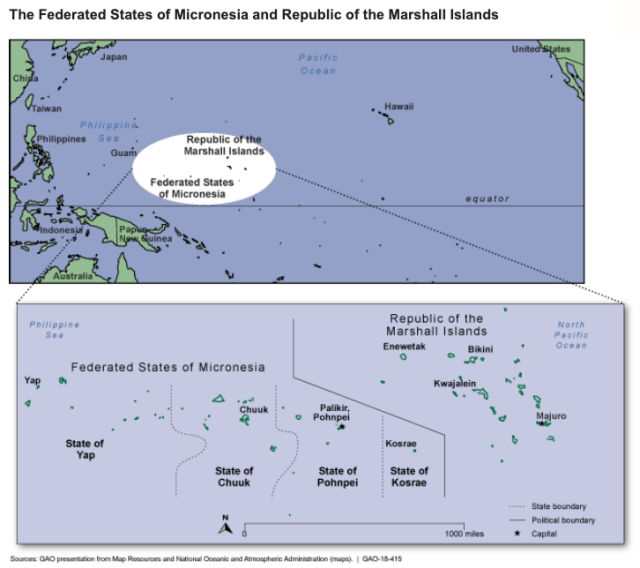
The Federated States of Micronesia and the Republic of the Marshall Islands rely significantly on U.S. grants and programs — $3.6 billion in economic assistance from fiscal year 2004 through 2023.
But the federal spigot will largely run dry in 2023.
Trust fund earnings for the FSM and RMI that “are intended to provide a source of income” after the grant money stops are not expected to “fully replace” expiring U.S. annual grant and program assistance.
That’s according to a new report from the Government Accounting Office.
It’s a lot of money and raises serious concerns about how the two nations, which have high out-migration rates, finite natural resources and limited industry, will be impacted.
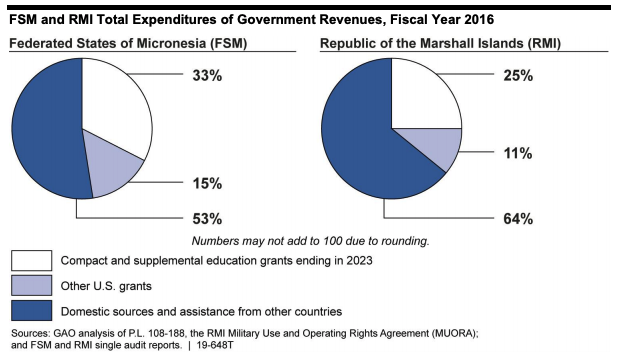
Under the Compact of Free Association — treaties agreed upon between the FSM and the RMI in 1986 and amended in 2003 — current financial assistance represents one-third of the FSM’s annual expenditures and one-fourth of the RMI’s.
Other U.S. funding will run out in 2024 — agreements providing U.S. aviation, disaster relief, postal, weather and other programs and services, although the GAO said some U.S. agencies may provide programs and services similar to those in the agreements under other authorities.
“As 2023 approaches, questions remain about the FSM’s and RMI’s ability to successfully transition to greater self-reliance when the 20 years of U.S. compact economic assistance end,” said David Gootnick, director of the GAO’s International Affairs and Trade and author of the report.

Gootnick said that trust fund committees “have not developed distribution policies, required by the agreements, which could assist the countries in planning for the transition to trust fund income.”
The committees have also not developed “the required fiscal procedures for oversight of disbursements or addressed differences between the timing of their annual determinations of the disbursement amounts and the FSM’s and RMI’s annual budget cycles.”
As Civil Beat’s series “The Micronesians” details, tens of thousands of Micronesians from COFA islands — especially in the Marshalls and the state of Chuuk — have moved to Guam, Hawaii and the mainland U.S. for economic, educational and medical purposes.