School Meals Flunk Local Food Test
Editor’s Note: This is Part 2 of a three-part series on food production in Hawaii. Part 1 covered the role of grocery stores and Part 3 will cover the challenges facing island farmers. The series stems from the experience this reporter shared in a diary of his attempt to meet the Kanu Hawaii Eat Local Challenge.
Every day in Hawaii, some 170,000 students walk through the door of a public school, and they’re not spending all of their time in a classroom or the gym. They need to eat.
Students in 256 schools consume 100,000 school-provided meals per day — that’s 15 or 20 million each school year. The state spends about $30 million annually to produce those student meals, making the school system a major — and potentially game-changing — player in the food system.
Those public dollars are now used almost exclusively to bring in school lunch ingredients from the mainland. Almost everything grows in Hawaii. But very little of the food ends up in the state’s school cafeterias.
Advocates of food sustainability in Hawaii are starting to push for that to change, but they’re finding a lot of obstacles in their way.
“I doubt we’re going to have 100 percent local meals going every day at lunch, but I think we can start doing a lot,” said Dexter Kishida, school food coordinator for the Kokua Hawaii Foundation’s Actively Integrating Nutrition and Agriculture (AINA) In Schools program.
The program encompasses school gardens, nutritional education and agricultural literacy, but Kishida said most of his time is spent working on ways to provide healthy — and local — school lunches.
Private charter schools are a good place to start grassroots projects, because they’re “a smaller ship to turn,” Kishida said. But the eventual target is an overhaul of the Hawaii Department of Education‘s school lunch program — the biggest game in town.
Rules, Regulations and Year-Long Contracts
Hawaii’s unified school district is the 10th largest in the country, a fact that School Food Services Director Glenna Owens is quick to point out. The state has a menu planning committee made up of school food service managers, per union rules. It meets quarterly to figure out how to design meals that satisfy federal nutritional guidelines for calories and vitamins.
“It’s really a science now,” Owens said in an interview at the School Food Services Branch headquarters on Koko Head Avenue in Kaimuki. “We can’t arbitrarily say we want local this or local that.”

School Food Services Director Glenna Owens explains the complexity of the program.
The five-week cycle menu is prepared a year in advance, and contracts with distributors are drawn up and signed long before any food hits lunch trays.
“Our challenge has been finding any local farmers that actually can produce what we use in our cycle menu and would be willing to sign a contract,” Owens said. She’s met with farmers and heard complaints from parents and local food advocates alike, but says the procurement process is extraordinarily complicated and doesn’t make buying local food easy. “There’s not enough farmers out there that are producing for our specific needs.”
A challenge for farmers, especially smaller ones, is that the department insists on one-year contracts. The state is required to meet standards set by the U.S. Department of Agriculture’s National School Lunch Program to be reimbursed for the cost of those meals. If a meal fails to meet the standards, the state loses funding. At the tune of tens of thousands of dollars per day in the event of a missing item, the state simply cannot afford the risk.
“If we don’t stick to the guidelines, we don’t get that federal reimbursement, that means we don’t get that funding, that means we can’t buy our food,” Owens said.
The distributors that do bid on the contracts are required to have a back-up plan in place in case an item isn’t available. Schools in Washington state can turn next door if their apple crop fails. But the volatility of Hawaii’s agricultural production and the vulnerability to a statewide drought or pest infestation make it impossible to, for example, rely regularly on locally grown apple bananas.
“We don’t have that luxury of Plan B,” Owens said.
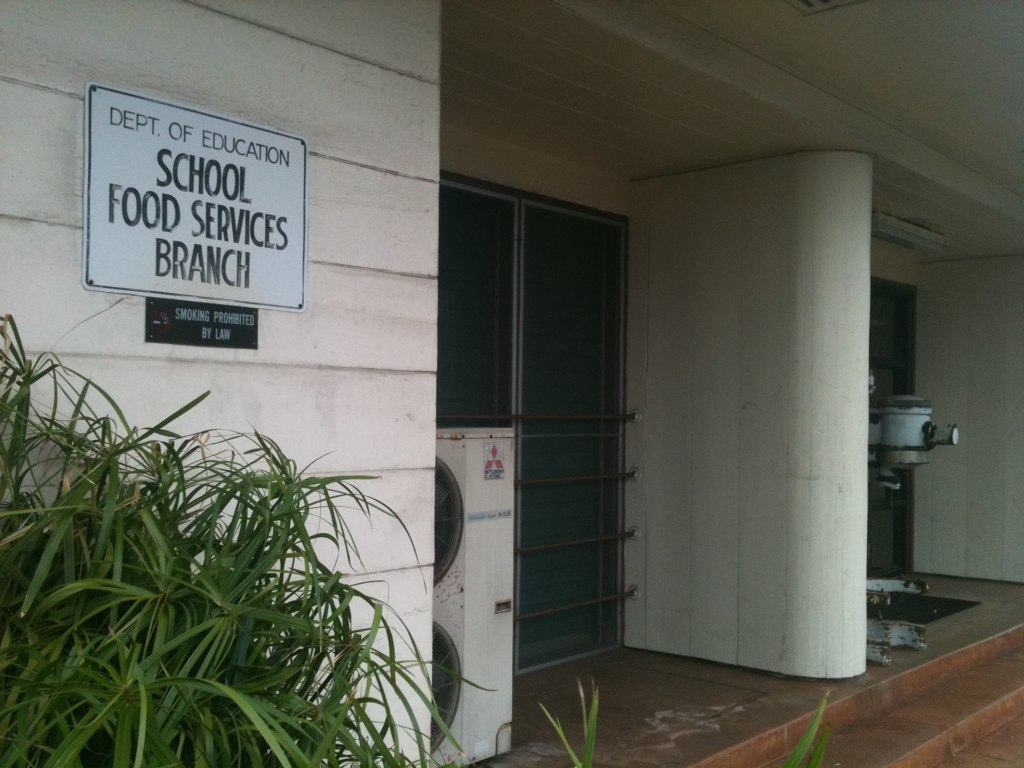
The DOE’s School Food Services Branch sets the menu for thousands of students.
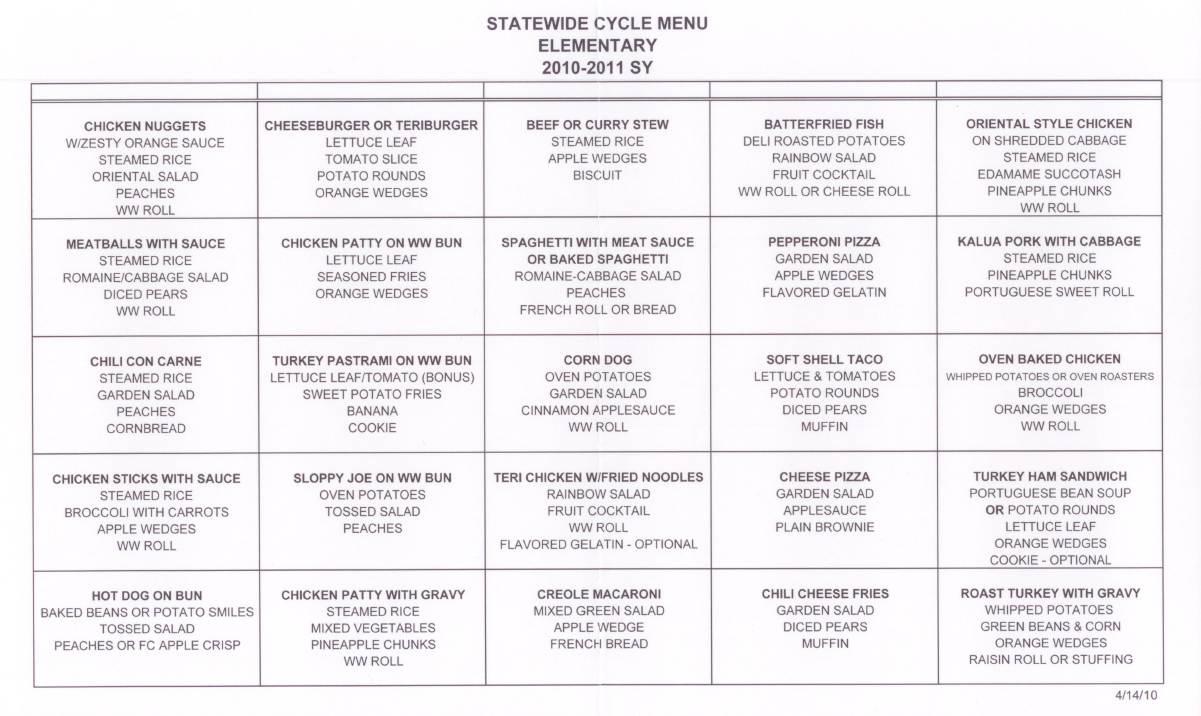
The five-week cycle menu for Department of Education elementary schools. (View Larger)
Not All About the Money
Owens thinks a lot of farmers are also reluctant to enter into a contract with the state because they can get better prices selling high-end, gourmet items to hotels and restaurants. But she said even if money were no object, meeting the DOE’s needs would still be daunting.
The state received $1 million from the U.S. Department of Defense under the Fresh Fruit and Vegetable Program [pdf] to purchase local produce for a handful of schools that had a high proportion of students eligible for free or reduced-price meals. But Owens said that even with an essentially unlimited budget, it was “disheartening” to find that farmers still couldn’t come through.
The problem has myriad causes, but one of the most obvious is that the schools are limited in what they’re allowed to serve. Owens said that any food provided to students must pass food safety standards — a high bar for some small farms that generally focus on farmers markets.
The department cannot accept donated items due to liability concerns. If one student were to become ill after eating donated food, it could cost the state money.
For those and many other reasons, experts have expressed misgivings about the future of a farm-to-school program. When the Hawaii Legislature asked the University of Hawaii College of Tropical Agriculture and Human Resources to consider the viability of such a program in Hawaii public schools, the answer wasn’t encouraging.
“Without a change of the purchasing practices of the Department of Education, and potentially, legislation, establishing a state-wide farm-to-school program that involves state-wide procurement of locally produced fruits and vegetables for the entire program this effort is not feasible,” the December 2009 report [pdf] stated.
The report expressed skepticism about scenarios that would see schools purchase directly from individual local farmers, farmer cooperatives, farmers markets or traditional wholesalers.
Salad Bars and the Future of School Food
Kishida hopes that a nonprofit co-operative or umbrella distribution organization can one day move the ball forward and provide the redundancy and backup that will allow the state to buy local food for its students.
Until then, small grassroots programs are the ticket. The AINA In Schools program has implemented “fresh choice” salad bars at Aikahi Elementary School in Kailua, Sunset Beach Elementary School on Oahu’s North Shore and the Waialae Public Charter School in Kaimuki.
Kishida said he works with 12 schools and hopes four or five others might install salad bars this school year.
While not all of the vegetables are locally grown, the salad bar teaches kids to eat healthy. When combined with a school garden that shows students where fruits and vegetables come from, it could change the way they look at food, Kishida said, calling a school garden “the best marketing tool to teach the kids how to eat.”
Without that connection to the land, they might not even be interested in the salad, Kishida said.
“We could roll out salad bars statewide in every school, but what’s the point if the kids aren’t going to eat it?” he said. “We compete with a fast-food culture, so that’s a definite challenge that we have: getting the kids to actually eat a healthier diet.”
Owens has faced a similar battle in implementing the public school menu. After the DOE started using whole grains, students asked why the crust of their pizza was so brown. The solution: covering it with more cheese. A 6th Grade class at Honowai Elementary School in Waipahu told this reporter that their favorite foods are pizza, nachos, chicken nuggets and kalua pig.
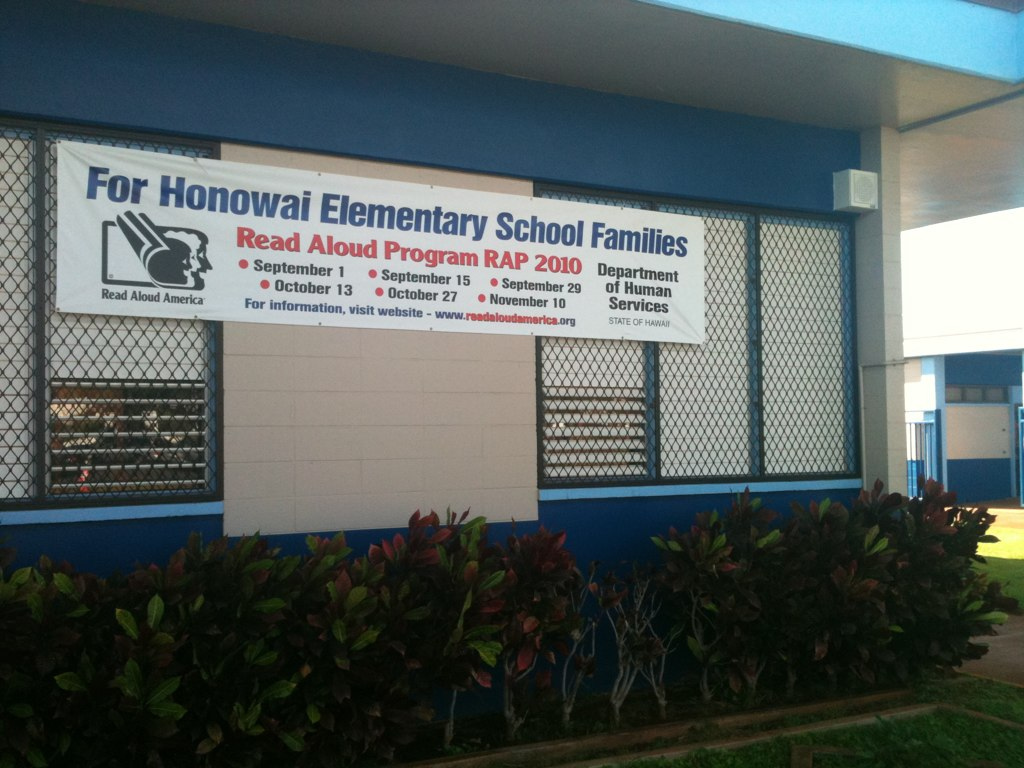
Students at Honowai Elementary in Waipahu said their favorite foods are pizza and nachos.
But there have been successes with using healthier ingredients. The schools have started to serve brown rice, and while older students accustomed to white are struggling with the change, a new generation of younger students is learning to love healthier options.
“Because that was on the menu, that’s all they know,” Owens said. She’s heard stories from the KTA supermarkets on the Big Island where items served in schools quickly fly off the shelves as kids teach their parents. “I’m using them as a little soldier to say, ‘I eat healthy in school.'”
Not only are the schools an important player because they’re spending $30 million a year on food. But they’re also teaching a whole generation of Hawaii citizens how to eat, and that generation can influence buying decisions today and for years to come.
Owens said she wants local, healthy options on cafeteria tables and thinks a community approach is required.
“Where do we go from here? Not as the Department of Education, not as the City and County of Honolulu, not as the farmers. For the state, where do we go from here?” she said. “If no one’s willing to take the first step, then you’re stuck in the mud.”