Possible Federal Shutdown Needlessly Threatens More Damage to Hawaii
The budget train wreck looming at the end of September in Washington, D.C., holds special dangers for this state, which is more dependent on federal funds than most.
Congressional budget analysts are now saying that another federal government shutdown over budget disagreements is likely at month’s end.
And by “another government shutdown,” let’s be clear from the start that we mean another entirely unnecessary, completely preventable and contrived, irresponsibly wasteful and destructive government shutdown.
Those who remember the shutdown of 2013 over the House of Representatives’ effort to defund the Affordable Care Act may recall the first 16 days of October for their widespread negative impact on Hawaii, where the federal government presence is a larger and more integral part of the economy than in most other states. Honolulu ranks second in the nation among cities in the percentage of its workforce dependent on a federal paycheck.
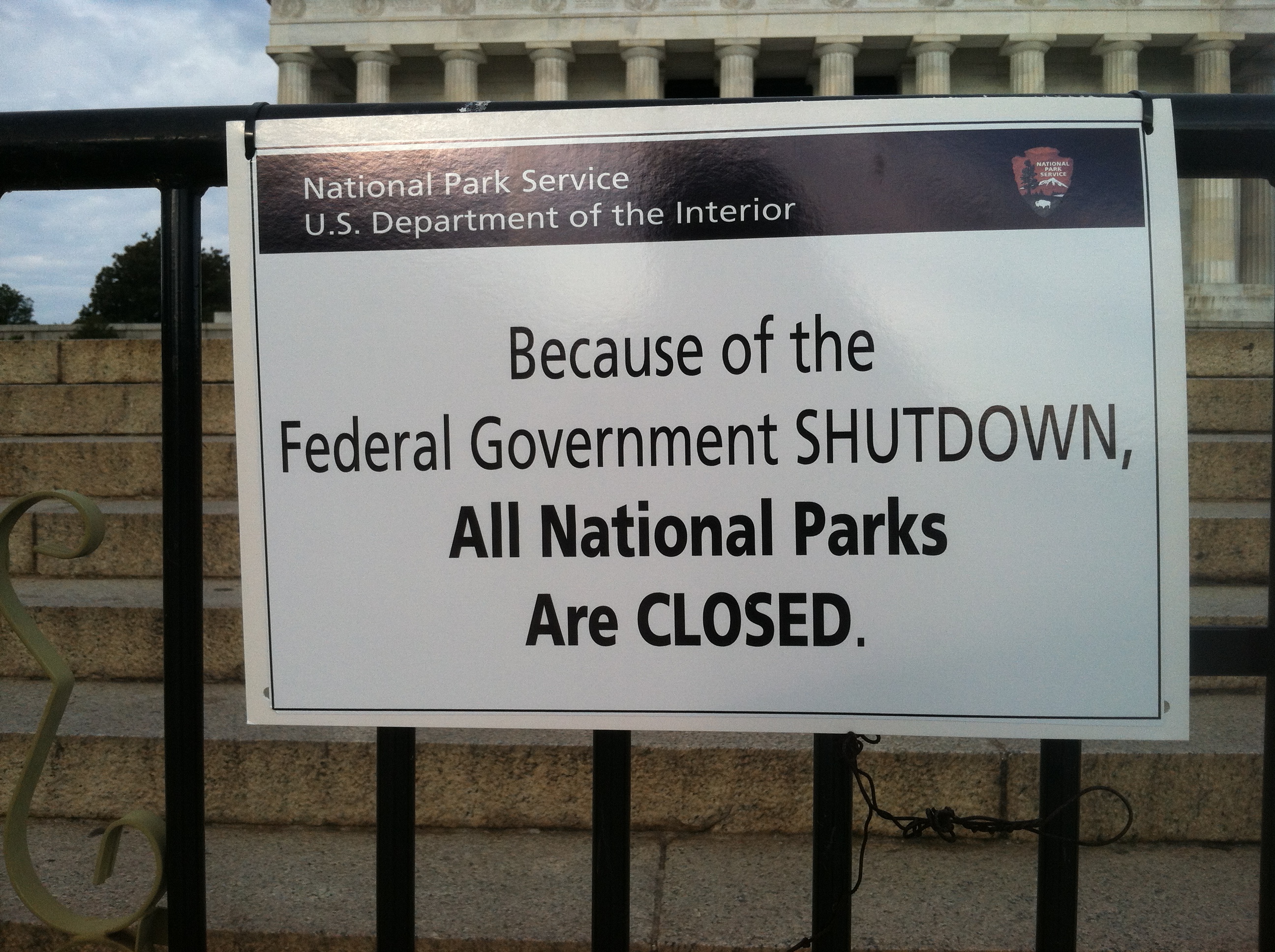
Signs such as this one in front of the Lincoln Memorial were common during the federal government shutdown in 2013.
NPCA Photos via Flickr
Facing withering national criticism over the belligerence of tea party-affiliated legislators responsible for the shutdown — lawmakers led by Texas Sen. Ted Cruz — Congress finally passed a bill fully funding the government on Oct. 17, 2013 which the president immediately signed. But the ripple effects were felt for months in communities around Hawaii and across the rest of the country.
Cruz’s arch nemesis in the GOP, Senate Majority Leader Mitch McConnell, R-Ky., swore in the aftermath of that debacle that there would be no government shutdowns on his watch — a promise he reiterated earlier this month.
“We have divided government. The different parties control the Congress, control the White House, and at some point we’ll negotiate the way forward,” McConnell told Washington reporters, according to The Hill.
It’s a pledge Hawaii Sen. Brian Schatz hasn’t forgotten. He didn’t mince words in a Civil Beat Editorial Board discussion last week: “This will be the best indicator of whether Mitch McConnell is in charge of the Senate or the tea party is in charge of the Senate. He does not want the government to shut down. His reputation as manager of the process is now on the line. If we end up at an impasse, it will be a clear signal that the tea party is in charge.”
The most troubling aspect of that potential scenario is the current status of the tea party. Nursing its special brand of never-ending outrage, which presidential candidates like Cruz and Donald Trump stoke daily, loyalists are on yet another losing streak, most recently highlighted by defeats on marriage equality and the Iran nuclear deal. They want a win, and as disastrous a prospect as a government shutdown might seem to many Americans, for the Tea Party it would be an opportunity to prove its potency, stopping normal business when its demands aren’t met.
Like the 2013 shutdown, a social issue lies at the heart of the current budget impasse. Federal funding for Planned Parenthood became a hot topic earlier this year when a secretly recorded and heavily edited video was released by the anti-abortion group Center for Medical Progress showing a Planned Parenthood official discussing procurement of fetal tissue from abortions.
“This will be the best indicator of whether Mitch McConnell is in charge of the Senate or the Tea Party is in charge of the Senate. He does not want the government to shut down. His reputation as manager of the process is now on the line.” — U.S. Sen. Brian Schatz
Abortion foes seized on the video as evidence that Planned Parenthood is brazenly profiteering by selling tissue from aborted fetuses, even though the release of the full, unedited video made it clear that neither the official in question nor the organization see the practice of providing fetal tissue for research as a “money making” opportunity or a “revenue stream,” according to FactCheck.org.
But tea party legislators and other abortion foes who have long had Planned Parenthood in their crosshairs now say they will oppose passage of budget bills unless all funding for the organization is stripped. This despite the facts that Planned Parenthood operates 700 health centers across the nation through 59 local affiliates and provides sexual and reproductive health care to 2.7 million men and women each year. Abortion services account for just 3 percent of its funding.
The budget battle over that 3 percent looms large for Hawaii, which USA Today called one of the 10 states most affected by the 2013 shutdown. Salary and benefits payments to the roughly 49,000 military personnel living in the state with their dependents would be halted, or at minimum, slowed, as would payments to civilian government employees. From Social Security check distribution to operations of national parks, most federal matters would come to a screeching halt.
But absent a measure that temporarily funds the government at current levels, that’s an almost certain prospect. Congress has passed none of the 12 spending bills that comprise the budget. With only 19 calendar days left in the month, even unified and motivated lawmakers would be unable to overcome the timing requirements embedded in the legislative process and pass a complete budget by the end of the federal fiscal year on Sept. 30.
It’s possible that House Speaker John Boehner could team up with Democrats as he did in 2013, passing a budget with only minority support from his own caucus. But Democrats are said to be demanding an end to sequestration — the cuts put in place during a 2011 impasse that kick in automatically when a budget can’t be passed. Republicans are about as likely to agree to that as they are to allowing Boehner to keep the speaker’s chair should he pass a budget without majority support from the majority party.
Hawaii businesses, colleges and universities and families that stand to be affected by this debacle should prepare themselves. By the end of the month, they may be in for a bumpy ride.