Self-Promotion Or Communication? Taxpayer-Funded Mailers Blur Lines
Constituent correspondence and campaign material is sometimes hard to tell apart.
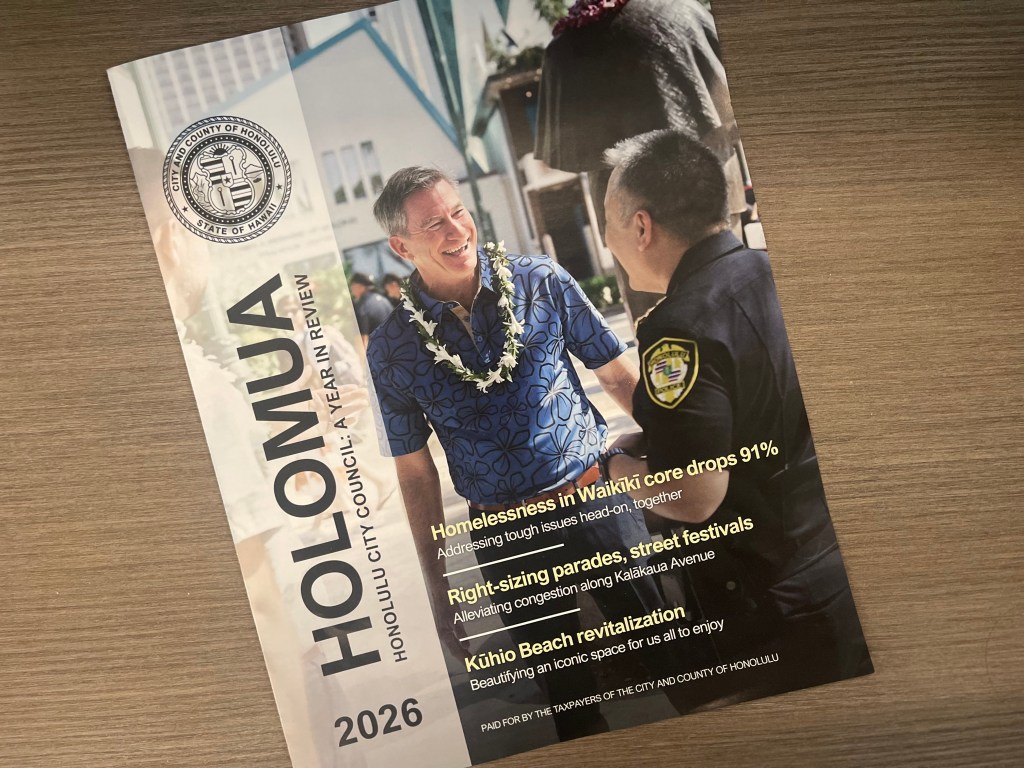
As Honolulu Council Chair Tommy Waters geared up for what has become a competitive race for reelection, his constituents received a multi-page promotional pamphlet of the ways he is “working for you.”
Covered by a full-page image of Waters laughing with a police officer in Waikīkī, the mailer highlights some of his greatest hits from the past few years, noting legislation as far back as 2020, and says Waters is “serving with integrity, effectiveness and compassion.” The mailer is typical of the kind of political flyers that hit mailboxes this time of year.
But Waters’ campaign donors didn’t foot the bill. Taxpayers did.
Waters is running against three opponents who would have to fundraise for campaign dollars or spend their own money to receive similar exposure. Hawaiʻi law prohibits using public resources for campaign purposes, but where to draw the line is a matter of interpretation.
“It strikes me this is too close to the election for candidates to use public funds to send out what is a thinly disguised campaign flyer,” said Colin Moore, a political analyst at the University of Hawai‘i Mānoa.
“This is a reason why incumbents are even more likely to win election. Not only do they have the name recognition and networks to fund their campaign, but they can benefit from these public resources to remind people of their name and their accomplishments.”
Honolulu Ethics Commission Executive Director Sandy Ma said it’s good for constituents to be aware of what their representatives are up to, “but we understand that ballots are hitting mailboxes shortly … and this does raise eyebrows.”
In a brief statement, Waters stood by his newsletter. “Mailers are a public information tool intended to keep residents informed about district projects, Council actions, public resources, and opportunities to participate in the decision-making process,” he said.

Blackout Periods
In several other jurisdictions and at the federal level, there are rules restricting when incumbent politicians can send taxpayer-funded mailers.
Members of Congress who are running for reelection are barred from sending mass communication to voters within 60 days of their contests. Several states have blackout periods. Lawmakers in Connecticut, for instance, have until July 16 in an even-numbered election year to send mailers. Washington state forbids the mailing of newsletters and brochures at public expense after a state lawmaker has declared their candidacy.
The Hawaiʻi House of Representatives has a similar rule, prohibiting the use of legislative allowances for mass mailings after the candidate filing deadline. The Hawaiʻi Senate has no such rule.
And no prohibition exists for the City and County of Honolulu. However, Ma said the Ethics Commission could consider it.
Camron Hurt, executive director of Common Cause Hawaiʻi, said Honolulu should institute a blackout period for mass communication to constituents during election time.
“That would do nothing but aid in people’s faith in government,” he said. “The only people who would object are incumbents or people who seek to abuse the system.”

In the race for District 4, which spans Waikīkī to Hawaiʻi Kai, Waters is running against two political newcomers — Jason Liang and Tara Malia Gregory — and his old political foe, former council member Trevor Ozawa.
It could be a tight race. In previous elections, Ozawa has twice beat Waters by less than 50 votes, although one of those contests was invalidated. Ozawa is now suing Waters to prevent his name from appearing on the ballot.
The Hawaiʻi State Ethics Commission, which oversees state employees, doesn’t appear to have weighed in on the ethics of election-time mailers. However, it did recently determine that it would be inappropriate for politicians to hang signs on public property if those signs prominently display their name, title and photo.
The commission was asked about two proposed signs stating “Drive With Aloha” that would conspicuously display a politician’s photo. Commissioners concluded that this kind of poster would violate Hawaiʻi’s Fair Treatment law.
Rather than simply conveying a message of roadway safety, the signs appear to promote the political officeholder, the commission said in its published opinion.
“Promoting safe and courteous driving near schools serves a legitimate public purpose,” the agency wrote. “But the proposed signs’ dramatic display of incumbent legislators’ headshots, names, and official titles is not reasonably connected to that purpose.”
Keeping Constituents Informed
Mailers are nothing new for council members, according to Taylor Ursulum, the council’s communications manager.
The funding for them comes from an annual contingency allowance that has been in place since 2003. The money can support official district office functions, she said, including “constituent communications, outreach materials, postage, printing, conference registrations, travel, and protocol expenses.”
“Public communication is a core legislative function,” she said. “Council members are responsible for keeping residents informed about projects, priorities, public meetings, and issues affecting their districts. Printed mailers are one way to reach constituents directly. This is especially critical for residents who don’t follow digital platforms and websites.”
It can be hard to say whether mailers fall under the category of genuine communication with constituents or if they more closely resemble promotional campaign materials, Ma said.
“Would a reasonable person take a look at the flyer and think that it is a promotional or campaign related material?” she said, adding that factors such as the timing and the size and prominence of a person’s image could weigh into this determination.
On the other hand, she said, a mailer that lists important municipal phone numbers for tasks like filling potholes or reaching a constituent services staffer more credibly fulfills a government purpose.
Waters’ mailer did not include any of that kind of information. But it highlighted several legislative efforts, including a bill that took effect this year that limits the amount of parades and festivals that close Waikīkī streets, and gave kudos to prominent people of the neighborhood.
“Most of these flyers tend to be a little more careful in how they use their official public flyers to present their accomplishments,” Moore said.
Waters constituent Winston Welch, who serves on the Diamond Head-Kapahulu-St. Louis Neighborhood Board, said he didn’t see a problem with his council member’s mailer.
“It very clearly says who paid for it. I don’t confuse this for a campaign ad at all,” he said. “I like having some positive news like this about what’s been accomplished. And I think we look towards our leaders to let us know: We are doing something with your money, and here are some of the highlights that we achieved.”
Other council members also took advantage of a recent offer from Waters’ office to cover up to $20,000 for physical newsletters to their constituents. Collectively, they sent tens of thousands of mailers containing pictures with community members and updates about local infrastructure. All of them included photos of themselves, albeit smaller than in Waters’ design.
Running unopposed for reelection this year, council member Val Okimoto highlighted recent wins for her community such as money allocated to pay for park improvements and the opening of a new medical center in Mililani. It also listed council committee leaders and information about how to submit testimony on bills.
Council member Tyler Dos Santos-Tam, who told constituents he envisions A City That Works, listed bills he has been working on to spruce up Chinatown as well as upcoming neighborhood board meetings and frequently called phone numbers. He faces one opponent in the upcoming election, Corey Morihara, who is a first-time candidate.
Council member Matt Weyer also included phone numbers for city agencies as well as a list of budget items relevant to his district, including funding for a new pool in Kahuku and new crosswalks in Wahiawā. Weyer is running for reelection without a challenger.
Council member Scott Nishimoto, who is not up for reelection, provided residents with options to save money in the face of rising sewer bills.
Council member Radiant Cordero updated residents on the statuses of local road projects, and she encouraged residents to sign up for the city’s emergency alert system and to submit issues they see around town via the city’s 311 system.
“These are issues that my office is being inundated with,” Cordero told Civil Beat. She said she appreciated the opportunity to send out so many mailers since they allow her to inform a lot of people at once about goings-on in her district.
“If anything,” she said, “I want more of it.”